Introduction#
Drop a glass on a tiled floor and it shatters into dozens of fragments. An ice cube left on a kitchen counter melts into a lukewarm puddle. We watch people grow older, never younger. This directional asymmetry is what Arthur Eddington termed the “arrow of time” - the intuitive, everyday reality that the past feels fundamentally different from the future.
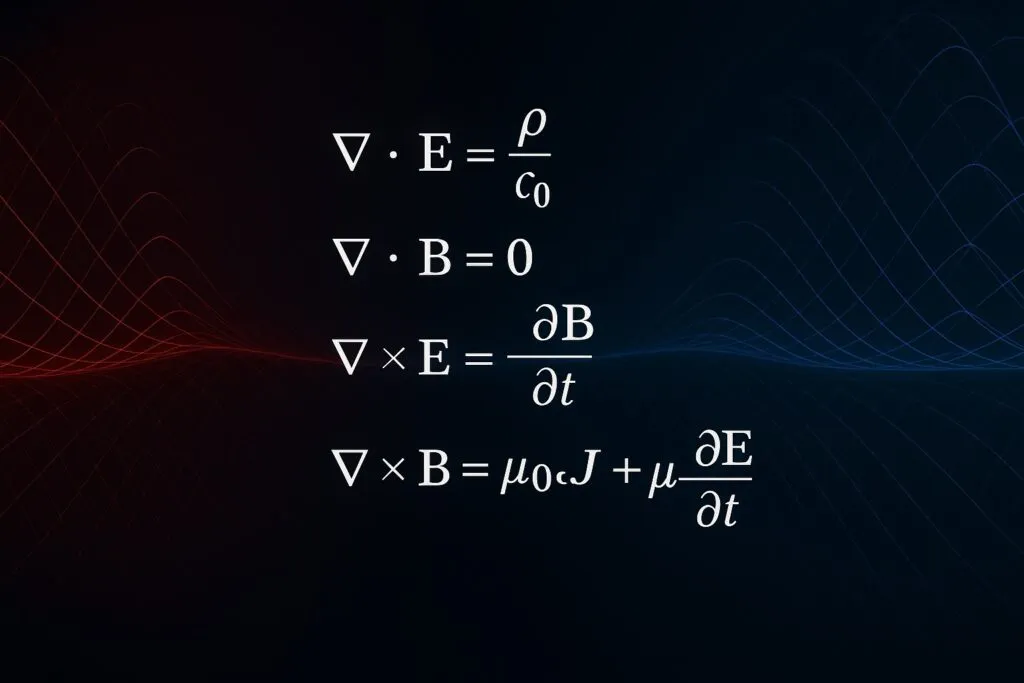
The real puzzle appears when you look at the fundamental laws of physics. Newton’s laws of motion, Maxwell’s electrodynamics, Einstein’s general relativity, and the Schrödinger equation are all time-symmetric. If you reverse the time variable (t -> -t) in any of these equations, the resulting motion remains physically valid. A video of two billiard balls colliding looks plausible whether played forwards or in reverse.
So what breaks this symmetry at macroscopic scales? What forces the universe along a one-way path? The answer is not built into the equations of motion themselves; it emerges from combinatorics and statistics through the concept of entropy.
What Entropy Actually Measures#

Entropy is frequently introduced as a vague measure of “disorder” or “messiness,” but this framing often obscures the real physics. A much more precise definition comes from Ludwig Boltzmann: entropy quantifies the number of microscopic arrangements (microstates) that correspond to a given macroscopic condition (macrostate).
Here, is entropy, is the Boltzmann constant, and represents the number of accessible microstates.
Consider the shattered glass. There are only a very small number of ways to arrange all of its constituent molecules so that they form an intact, pristine wine glass with a smooth bowl and stem. That macrostate has a tiny , meaning very low entropy.
By contrast, once the glass breaks, the fragments can land in an astronomical number of positions, orientations, and scatter patterns while still fitting the description “broken glass on the floor.” That macrostate corresponds to an enormous number of microstates.
The universe does not possess a mystical preference for destruction. Rather, systems evolve toward states of higher entropy simply because those states are overwhelmingly more probable. If a system continuously explores its accessible phase space at random, the odds of it spontaneously wandering into one of the handful of “intact glass” configurations are so small that you could wait many times the age of the universe without ever seeing it occur.
The Microstate Count#
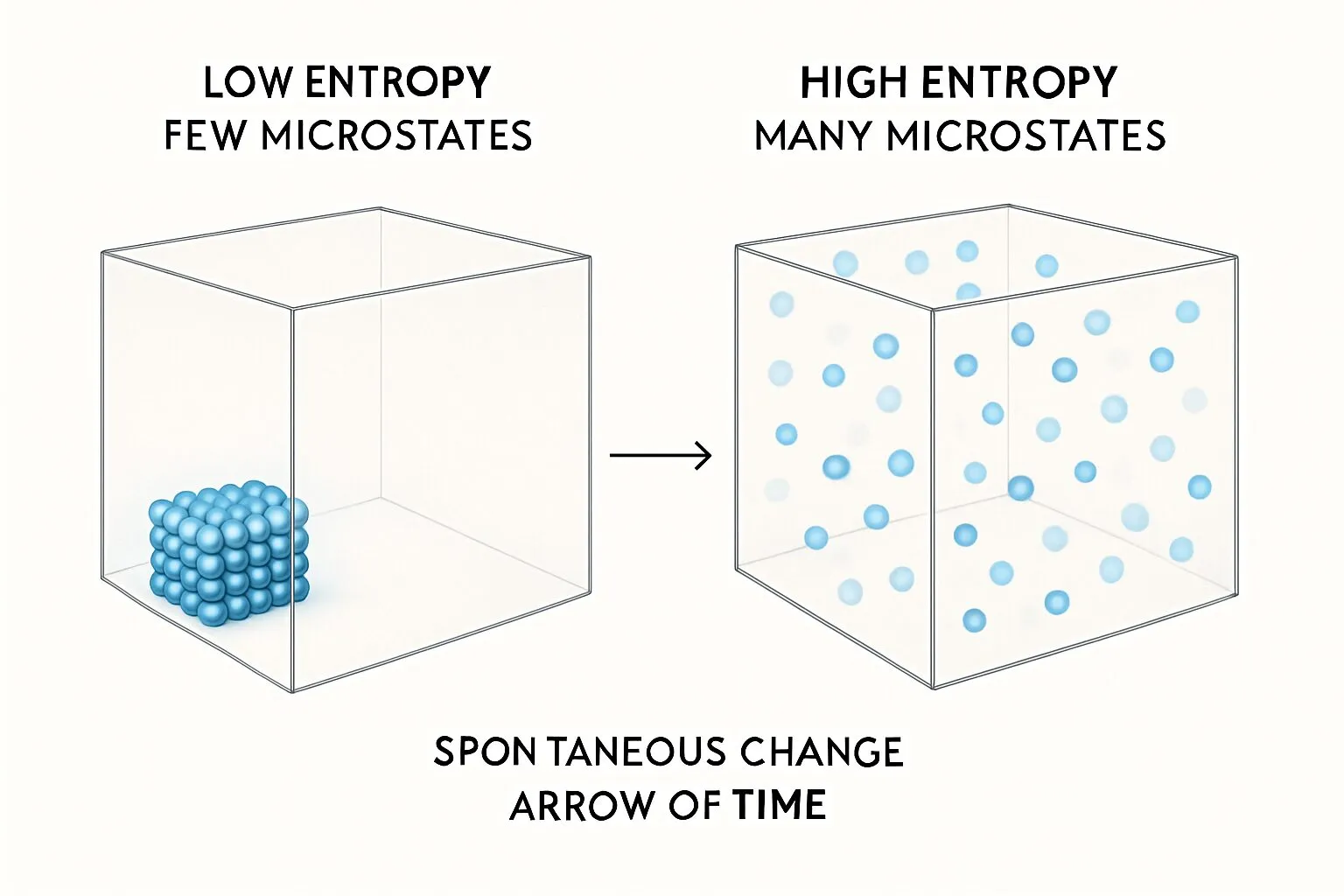
To see the mathematics on a small scale, imagine a container divided in half, containing just four gas molecules (A, B, C, D).
If we list every possible configuration:
- All 4 on the left: Only 1 combination (ABCD on the left).
- 3 on the left, 1 on the right: 4 combinations (A, B, C, or D on the right).
- 2 on each side: 6 combinations (AB, AC, AD, BC, BD, CD).
- 1 on the left, 3 on the right: 4 combinations.
- All 4 on the right: Only 1 combination.
Out of 16 total microstates, 6 (or 37.5%) have the molecules evenly split. If we scale this from 4 molecules to a mole of gas ( particles), the distribution becomes unimaginably sharp. The probability of finding all gas molecules grouped into one corner of a room by pure chance is effectively zero:
This is why gas expands to fill a vacuum. It is not being pushed outwards by a repulsive force; the particles are simply bouncing around independently, and the uniform state happens to represent the overwhelming majority of possible configurations.
The Second Law and Open Systems#
The Second Law of Thermodynamics states that in any isolated system, total entropy cannot decrease over time:
A common point of confusion is whether localized decreases in entropy violate this rule. We freeze water into structured ice crystals; living cells build intricate DNA polymers out of scattered nutrients; humans assemble semiconductors and construct buildings.
None of these violate the Second Law because neither a freezer nor a living organism is an isolated system. They are open systems that exchange energy and matter with their surroundings.
When a refrigerator cools water into ice, the entropy of the water decreases (). However, the refrigerator’s compressor consumes electricity and releases waste heat into the surrounding kitchen air. The thermal entropy generated in the room () strictly exceeds the entropy lost by the ice:
Living organisms survive by drawing in low-entropy energy (such as sunlight or chemical energy from food) and exporting higher-entropy thermal waste into their environment. Erwin Schrödinger described this in What is Life? by noting that organisms maintain their internal structure by continually drawing “negative entropy” from their environment.
The Past Hypothesis and the Ultimate Fate#
If entropy always increases, it implies something profound about the origins of the universe: the early universe must have started in a state of extraordinarily low entropy.
Cosmologists call this the Past Hypothesis. Roughly 13.8 billion years ago, matter and energy were distributed almost uniformly throughout space at immense density and temperature. In a system dominated by gravity, a smooth distribution of matter actually represents extremely low entropy, because gravity naturally tends to clump matter together into stars, galaxies, and black holes (which possess astronomical amounts of Bekenstein-Hawking entropy).
The expansion of space and the condensation of matter into stars has allowed the universe to spend billions of years gradually climbing the entropy ladder. Every star burning hydrogen, every geological process, and every biological metabolic cycle is another step along this statistical gradient.
Eventually, on timescales of years and beyond, all stars will burn out, matter will decay or fall into black holes, and those black holes will gradually evaporate via Hawking radiation. The universe will approach thermodynamic equilibrium, often called the “heat death.” At that point, with no free energy gradients left and entropy maximized everywhere, macroscopic change ceases, and the thermodynamic arrow of time effectively runs out of track.