Fermi problems are a unique type of challenge that set out to do one thing: answer the unanswerable. By using logic and estimated sums, you can approximate the value to questions which would be either impossible or unfeasible to measure. It’s precisely this intriguing nature that led me to take them up as a fun exercise to test my application of physics.
Fermi, a renowned physicist, would pose such problems to his students to teach them the power of estimation and logical reasoning. For the piano tuner problem, he wouldn’t expect anyone to know the exact figure. Instead, he would guide them to break down the large, seemingly intractable question into a series of smaller, more manageable estimations. This involved considering factors such as:
-
The population of Chicago: A reasonable estimate for the city’s population at the time.
-
The average number of people per household: To estimate the number of households.
-
The percentage of households that own a piano: A guess based on general observation.
-
How often a piano needs tuning: Perhaps once a year, or every few years.
-
How long it takes a piano tuner to tune one piano: A few hours, for example.
-
The number of hours a piano tuner works in a year: Standard working days and hours.
By multiplying and dividing these estimated quantities, one could arrive at a surprisingly close approximation. While the exact figure isn’t the point, the process of logical breakdown and estimation is. Fermi himself, known for his quick calculations, reportedly arrived at an estimate in the low hundreds, demonstrating that even without precise data, a reasonable answer can be found through structured thinking.
Personally I have found the value of Fermi problems to be the application of what I am taught in school to real-life problems, which solidifies the concepts and allows me to see the utility of what we have been taught, tying concepts together. Fermi problems also often encourage out-of-the-box thinking which is particularly important for the tougher a level physics problems, physics olympiads (which I received Gold in) and various other problems I come across online. These unique problems allow for a further final benefit and that is that they are simply a lot of fun to solve!
Below are some of my favourite Fermi problems that I’ve created, completed and verified.
What is total kinetic energy of all the rivers in the world in one year assuming no friction?#

-
Rainfall on land: We need to work out the total amount of rainfall on land, as this feeds rivers. We take an average estimate of 1,000 mm (1 m) of rain falling on land each year.
-
Total water volume: Using the surface area of the Earth from its approximate radius (), , so a metre of rain over it is about of water.
-
Total mass on land: Multiplying by the density of water () gives . Since only roughly 30% of the Earth is land, the mass falling on land is approximately .
-
Runoff losses: Not all water reaches rivers; much is lost to evaporation, transpiration, plant uptake, and isolated endorheic basins. Reservoirs that don’t feed back into the sea and agriculture take their share too. We assume this happens to around 60% of the water.
-
Effective distance factor: The water that is lost still flows partway before it goes, so it still carries some kinetic energy. We count it at half weight, assuming on average it travels half as far as the rest. That makes the multiplier , giving an effective flowing mass of .
-
Gravitational Potential Energy: The mean elevation of land above sea level is approximately 840 m. Using :
-
Total Kinetic Energy: Assuming negligible frictional dissipation in this idealised estimate, all GPE converts to kinetic energy before discharging into the sea: roughly per year. For context, that is roughly one-seventh of humanity’s annual energy consumption, or 390 of the most powerful bombs ever detonated.
How many photons are emitted in one night by all the Lamp posts in London?#
-
Total road network length: Estimate London’s road network at roughly 15,000 km.
-
Lamp post count: Assuming 70% of roads are lit with an average spacing of 30 m between columns:
-
Luminous flux to photon rate: A typical high-pressure sodium or LED street luminaire produces around 15,000 lumens. Using the optical conversion factor of , each luminaire emits:
-
Nightly duration: Standard UK annual burning hours are approximately 4,000 hours/year, which averages to (39,600 seconds).
-
Photons per lamp post per night:
-
City-wide total per night:
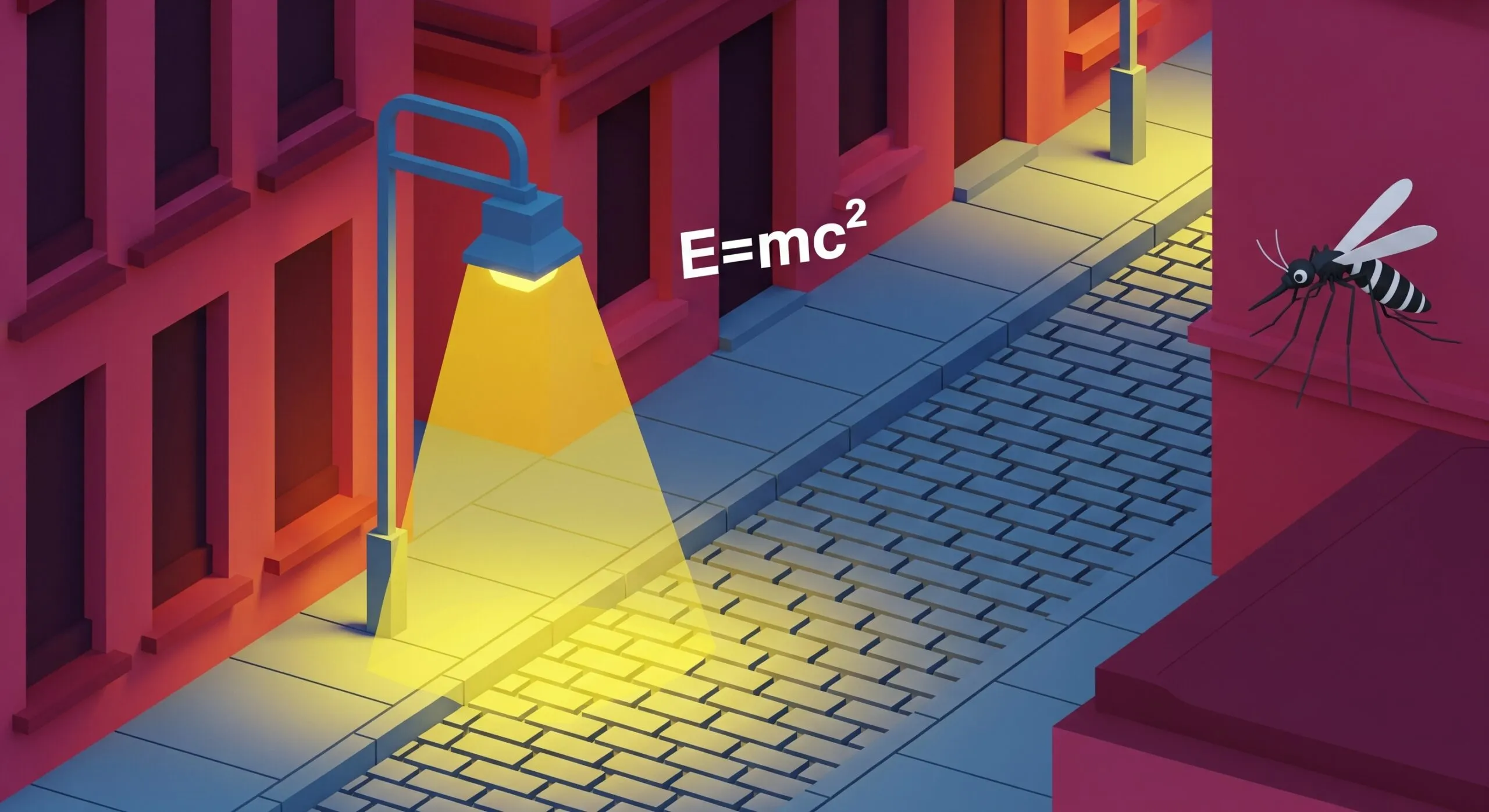
This astronomical value, if converted into energy (using green light for simplicity), would be equal to only the mass of a single large mosquito. In other words, each night London’s streetlights output enough energy in the form of light to create a mosquito by nuclear fusion.